
Ovapedia search :
Title:
Reading the article by Philip Greenhow on the secret accounting code used by Robert Lipscomb, based on the word “sympathize”, I recall the one used by my Grandfather, William Wentworth Daniel (1881- 1959).
Background
W W Daniel was born in Holsworthy, the eldest son of a cattle dealer and farmer, but he left home to take an apprenticeship in Exeter in the cloth trade. In 1905 he married Ethel Hope Townsend, Draper’s Assistant, (1877-1954) in Topsham. They settled in Budleigh Salterton, renting 4 High Street, Budleigh Salterton (also known as London House) running it as a Draper and Haberdashery. William Connett had previously run it as a Draper and Outfitter.
William Wentworth finally bought it, with cottage at the rear in Queen Street, from the Connett Family Trust in 1944 for £1,900. At the same time he also bought for £86 the Connett Leasehold Redemption Insurance Policy for £1000 “against the time when it falls into hand” (head lease reverts) to the Rolle Estate. The drapers was run by the family for 59 years by himself, his daughter Nora Eileen (Betty) Daniel (1909-1965) and son William Townsend (Bill) Daniel (1911-1996), who eventually became incorporated as W W Daniel & Son, but who sold it in 1964 (2).

Original sign placed under each window
The 1911 census records the following all living on the premises of 4 High Street: William Wentworth himself, his heavily pregnant wife (William Townsend was born 16 May) and three year old daughter; his brother Sidney Brimacombe Daniel, an assistant in the business; two drapery assistants (Blanche Hopkins and Ethel Lane); a dressmaker (Ruth Smale); and a local girl, Minnie Gooding, as general servant. (Sidney went on to own the Steam Laundry situated at the corner of the East Budleigh Road and Mansfield Terrace, now demolished.)
The family lived over the shop until Moorhome, Moor Lane, was purchased in 1934 from Major Grey Simpson for £1,550. In the High Street in 1911 there was a fancy draper at No. 3, a Baker at No. 2 and a florist at No. 1. At some stage, soon after, W. W. Daniel & Son was renumbered from No. 4 to No. 3, presumably during redevelopment of the original Numbers 1 to 3. Photographic evidence shows that this redevelopment post dates the building of the Victorian premises occupied by W. W. Daniel & Son and is consistent with the Edwardian architecture of the single structure currently comprising Nos. 1 and 2 High Street.
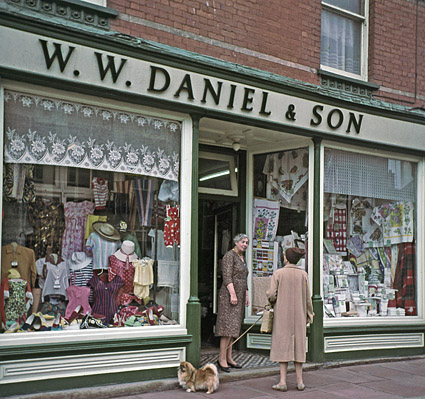
W.W. Daniel & Son c 1960, Betty Daniel in the doorway.
Secret Codes
The secret code used for marking the price on goods was based on the ten letter phrase “Be thankful”, like the word chosen by Lipscomb it carries a rather poignant sub text. As with Lipscomb, the first letter in the phrase represented the number one and the last the number ten or zero, so B=1, E=2 etc.
In addition, W,x,y & z were also used, the W for eleven so that in the duodecimal system, where twelve pence equals one shilling, the code did not give away a double digit price. Lower case x, y & z were used for the farthing, halfpenny and three farthings. Decimalisation of the currency was not introduced until 1971. (On my very occasional stints in the shop, one of my nightmares was having to work out the price of so many eighths of a yard, where the yard price contained farthings. One learned very quickly to round up. Luckily for me, the farthing stopped being legal tender at the end of 1960).
You can see that the system is principally designed for items priced in small numbers of shillings and pence and has redundancy. Larger items such as sheets and blankets, costing pounds, were also priced in shillings.
So, where a price in shillings and pence might be conventionally written as 3/4½, meaning three shillings and fourpence halfpenny, after translation via the code it would become T/Hy. But there was a further twist. In the William Wentworth system the shillings and pence were actually reversed so that the code as written would change to Hy/T.
In this photograph of some buttons, still in family possession, the coded price can be seen to be F/B which from the explanation above can be seen to translate back to one shilling and eightpence. It was believed within the family that H Carter & Sons, Ironmongers, used the same basic code (not reversed).
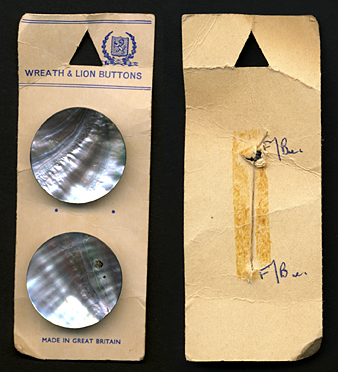
Button as priced
There were three purposes for covert pricing. The obvious one was to make it difficult for competitors to keep track of your prices. The less obvious ones were designed to give the entrepreneurial spirit free rein.
With no clear marking of prices except for goods in the window, customers had to initiate dialogue with staff to enquire about the price of any goods, opening up opportunities. With a “guide” price marked in code a good salesman (or woman) could then adjust the price upwards or downwards to suit the circumstances. Awkward or highhanded customers paid over the odds, whilst those making multiple purchases, or who were known to be regular customers with good credit, obtained discounts.
For goods with a slow turnover, such as in drapery, the retail mark-up could be as high as 50% offering considerable scope for flexible pricing. For faster turnover goods such as groceries it would be more like 12½%, with little scope. (Discounts of 2½% (6d in the £) were also given by wholesalers for payment within two weeks). Covert pricing finally came to an end as part of Ted Heath’s Abolition of Retail Price Maintenance Act of 1964 which outlawed a range of restrictive retail pricing mechanisms (3).
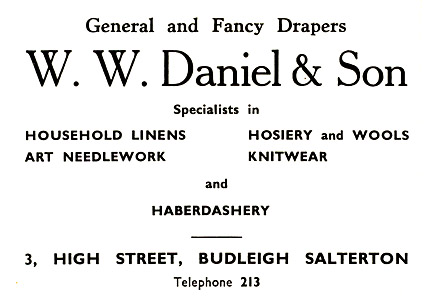
Advert 1960
Researched and written by © David Daniel, 2011
The Author would like to thank Robin Holt for a number of very helpful suggestions to improve clarity made during proof reading.
References:
1.Estate valuation methods and secret codes, 1883, Clinton Devon Estates, Philip Greenhow, OVApedia, EB-G-00003
2.Family archives.
3.Richard Finlay, Queen Mary and Westfield College,University of London,”The Conservative Party and Defeat: the Significance of Resale Price Maintenance for the General Election of 1964”, Twentieth Century British History, Vol 12, No 3,2001, pp 327- 353.
118 BS-G-00011 Biography any