
Ovapedia search :
Title:
Taxes, Duties and Smuggling
The raising of state revenue by levying taxes on imported wine and exported wool dates back to Ethelred II in Saxon times(1). The earliest record found for smuggling in the Otter Valley comes from a court case in which eight men of Otterton and one of East Budleigh were convicted of smuggling 35 bags of tobacco in 1684 (2). Obviously, the higher the tax the greater is the incentive to avoid it; and the heydays for smuggling were during the C18 and first half of the C19 when vast increases were made to customs duties levied on tea, spirits, tobacco and silk. This was to pay for wars with Spain then France, starting with an Act under William III.
By the 1780’s, for example, it was estimated that over half of all the tea imported was contraband (3) and the anonymous author of a pamphlet wrote: “Thousands... who would otherwise be employed in fishing, agriculture etc, to the emolument of this kingdom are now supported in drunkenness, rioting, and debauchery by their iniquitous traffic; - a traffic obviously productive of so numerous a train of evils, that prudence, common honesty, decency, order, and civil government, unitedly cry out for redress.” The smuggling of tea vanished virtually overnight when Pitt the Younger slashed this particular tax in the Commutation Act of 1784 from 119% to 12.5%, replacing it with the more easily collected window tax, the other taxes remained.
Most members of the public didn’t regard smuggling as a criminal activity, despite harsh legal penalties, because smugglers provided the communities with goods they could not otherwise afford. The involvement of pillars of society such as members of the clergy in smuggling is recorded in a companion OVApedia article (2).
Smuggling was so profitable that the smugglers could afford to employ a large labour force to man cutters, galleys, cruisers and luggers that could outrow or outsail the Royal Navy at sea (Cawsand on the Cornish side of the entrance to Plymouth Sound had a reputation for building the fastest boats). There were also well organised teams to land, hide or transport swiftly the goods inland and outnumber any “Riding Officers” that got in the way. “The Riding Officers” were formed in 1698 as the oldest branch of the preventive service (1). Their job was to prevent smuggled goods, which had eluded the established Revenue Cruisers and Customs officers, from moving inland by patrolling up to ten miles inland (but they were of dubious effectiveness).
The Revenue Men
Customs Officers were responsible for collecting the duty and the Royal Navy patrolled the sea. By 1713 troops of dragoons were stationed along the whole southern coastline with orders to assist the Customs Officers in an attempt to beef up the ineffectual Riding Officers. The first record of an RN officer being posted to Budleigh Salterton dates from a 1773 lease (4). A “King’s Boat” was certainly stationed in the town in 1786 because in an advert placed in the Exeter Flying Post (5) HM Customs offered a reward of £5 for its recovery, it having been lost from its moorings on Tuesday 5th December of that year. Was this boat lost due to inclement weather or a badly tied bowline or was it deliberately cut adrift? The 1841 census records that there were four coastguards and their families living in Budleigh Salterton, probably the crew for a gig. They are likely to have been commanded by an officer with RN rank.
A range of terminology is used to report custom and coastguard actions through this period: King’s men; Revenue men; Customs Officers; Preventive Officers; Coastguards etc. As part of a Treasury led and funded initiative a third cordon force was created in 1809 to operate in coastal waters, to tackle smugglers who had eluded the Revenue/RN cruisers operating farther out to sea. This force was named “The Preventive Water Guard”. Chief Officers had to maintain their boats in a state of readiness to put to sea at all hours, usually using a four-oared gig. Although prevention of the running of contraband was their primary object, the Water Guard was also made responsible for giving every assistance to saving life when a ship was wrecked (and for taking charge of the wreck).
Formation of the Coastguard
By the end of the Napoleonic War, the preventive water guard was responsible to the Treasury, the preventive cruisers to the Admiralty and the riding officers to the Board of Customs. There can be little doubt that direct oversight by the Treasury ensured results from the newly formed water guard which had eluded the previously established forces of law and order. But in 1822 a compromise had to be found to sort out these competing responsibilities. The Treasury agreed to reduce the revenue cruisers and to transfer the Preventive Water Guard to the Board of Customs whilst giving the Admiralty responsibility of appointing the officers. The preventive services comprising water guard, cruisers and riding officers were given by the Treasury the collective name of the Coast Guard, to become generally known later by the single word “Coastguard”. (1)
To prevent collusion with the smuggling fraternity Coastguards were forbidden to engage in any form of trade, or to own or possess a share in any public house or shop, or to own a boat. Life was hard, Coastguards frequently worked a 16-hour day, mostly at night. Instructions were issued just before a duty period but could not be communicated to families. No man had charge of the same guard on successive nights. Uniform was obligatory and all men received musket and cutlass drill. Coastguards did receive prize money shared according to rank on a published scale. Coastguards were also held responsible for all smuggling in their district. “A list will in future be kept of every person serving at a station within which a run took place, and that no such officer or man will be considered eligible for promotion or entitled to any mark of indulgence or favour.” (from orders 1829).(1)
Coastguard Action in Budleigh Salterton
Here are some examples of local Coastguard action, but see also (2). In 1835 The Chief Officer of Coastguards at Budleigh Salterton was Lt. Clay. With his Chief Boatman they were assaulted on Budleigh Salterton beach by smugglers but managed to seize 52 tubs of brandy and geneva; a William Rattenbury was arrested. In 1820 HMS Scourge (Revenue Cruiser) recovered 80 tubs of spirits off Otterton Ledge which had been dropped by John Rattenbury from the boat "Hannah". The Scourge caught up with the Hannah off Salterton and drove it onshore by gunfire below High Peak. John Rattenbury (father of William above) got away. In 1824 Philip Hodnett, boatman stationed at Salterton was violently assaulted by a gang of smugglers on Chiselbury (inaccessible from land). This action-packed first half of the century sets the context for the subsequent increase in Coastguard establishment.
Reports from the Treasury show that the Coastguard was getting on top of smuggling from around 1839, and their role gradually changed. For example, from 1831 the Coastguards had provided a formal RN reserve. Coastguards were drafted for the Crimea War in 1854 and this role was progressively strengthened with more training duties until it became the dominant one from 1862. Again the Coastguards were drafted in 1914 for WWI. (1)
Lifesaving was a formal secondary duty. It is worth recording the rescue of seventeen of the hands of the Spanish 800-ton steamer “Independiente” wrecked at 4am one and a half miles east of Budleigh Salterton, as recorded in the Times of 1856. The men were landed safely on Salterton beach through “tremendous surf” by the crew of the Longboat. This provides documentary evidence that by 1856 there was a Coastguard Longboat and crew at Budleigh Salterton, a considerable increase in the establishment of 1841, since the longboat needed a minimum of eight oarsmen.
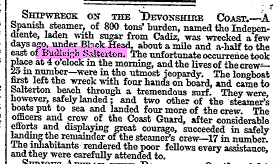
Times 1856
Despite having effectively halted smuggling by mid-nineteenth century, a presence in coastal waters remained a formal requirement of the Board of Customs to protect revenue, even though the funding of the Coastguard had become an Admiralty responsibility in 1856. This was a subject of considerable interdepartmental wrangling between Customs and the Admiralty as the latter attempted to cut costs and was still unresolved at the outbreak of WWI. Throughout, the Coastguard remained responsible for taking charge of wrecks, and for saving life in places such as Budleigh Salterton where no RNLI lifeboat station was formed.
Budleigh Salterton Coastguard Stations
An early Preventive Service watch house, later the first Coastguard station and boathouse, was built at the midpoint of the beach (circa 1820) and, from census records, we know that the Coastguards themselves occupied lodgings in the town. The reason that a structure was provided for the boat, when all other boats were left on the beach in the open, was obviously for security, as evidenced by the report of the lost boat in 1786.
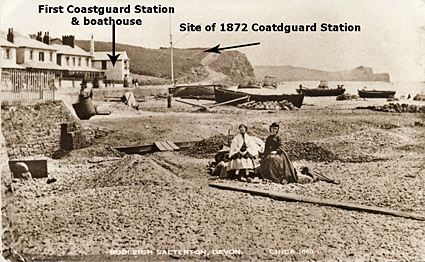
First Coastguard Station
In 1866 the Clinton Estate (Freeholder) (4) gave notice that it wished to end the current lease of the Coastguard station in exchange for a new site, in order to develop the Marine Parade. This coincided with a decision in the Admiralty during the 1860s to stop renting Coastguard Stations and to buy them outright as part of cost control. In 1872, it was agreed that a new, and larger, Coastguard station should be built on land owned by Lord Rolle, linked to a boathouse on the seafront by a set of brick steps.
The replacement site chosen on the top of a small prominence at the eastern end of the town was highly appropriate. There was room to provide a watch house and custom built accommodation for the officers and men. From here the Coastguards would be distanced from the townsfolk and could dominate and survey the whole bay. It also provided an ideal signalling site. Plans for the complex, signed by John Haite, assistant civil engineer to the Admiralty and based at Devonport, are dated 20 February 1873. Exactly when the complex was built is uncertain.
It included a terrace of eight coastguard cottages, two Petty Officers' cottages, and a larger Officer's House with associated WC and coal sheds to the north and east of the site. There was a watch house and a flagstaff to the south (now demolished), and a rocket cart house and a wash house to the north; the rocket cart was use for firing emergency lines to ships in distress. The complex was enclosed by a boundary wall which is higher to the north of the site to conceal the outbuildings from Coastguard Road. This was a stipulation made by Lord Rolle: Budleigh Salterton was a planned resort within the Rolle estate, which was anxious to maintain its dignity and social cachet. The building plans were approved by Robert Lipscomb, Steward of the Rolle Estates, on the 8 April 1874 (6).
This Coastguard Station is one of the best surviving examples in the country, in part, no doubt, due to the attention Lipscomb paid to the details of design (7). Only the grade II buildings at St Agnes, Cornwall and Kings Lynn, Norfolk are comparable. Budleigh Salterton has added interest in the survival of the rocket cart house, which is an extremely rare survival of this building type and an important physical reminder of the use of rockets as a life-saving apparatus (only two others are known, one of which is at St Agnes).
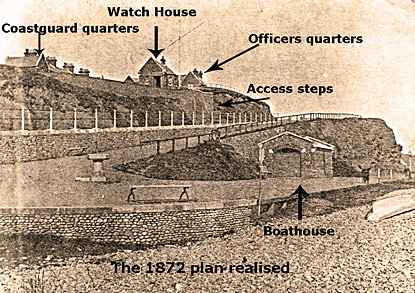
Second Coastguard Station
The Coastguard Station was grade II listed in January 2010, but not the Boathouse. The omission of the Boathouse was reviewed on appeal. The plans of the Coastguard Station carry a date of September 1873 and do not include a boathouse. The architect's drawings for the Boathouse carry a date of April 1874. The Minister was therefore persuaded that that the Boathouse may not have been planned as part of the original Coastguard Station and may not have been as important to the function of the Coastguard Station as may be supposed. He was also persuaded that the alterations and losses to the structure over the years leave it as a poor example and since it is no longer a good representation of a late C19 longboat house it was not worth listing.
Very few listed buildings remain just as they were constructed. Most have been compromised to some degree in the past by alterations reflecting changes in the social history of their use. (The Longboat has been used as a beach café now for at least 90 years which has ensured its continued survival). In this case the detailing shown in the plans will still be in place under the render, applied as weather protection, and the original roof is still intact. There have been window and door penetrations and a small extension to the east. But its original purpose can easily be seen. It is, at the time of writing in January 2011, the only known surviving example in the country, but has planning permission for its demolition.
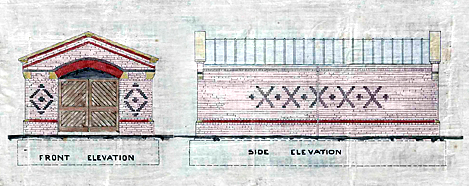
Detail from original Boathouse plan
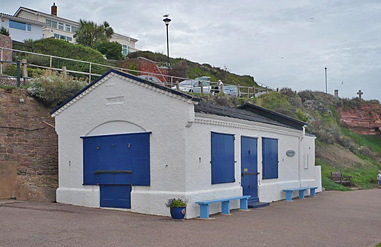
Longboat House as at 2010
The Longboat
This oral history of G Mears, a member of one of the fishing families, of his recollection as a boy watching the boat drill still being actively practiced c1900 was recorded c1960 in Fairlynch Museum:
"The Coastguards Watch House, when sited on the hill, used to be a real landmark for the sea front at Budleigh. To look up and see this little place with a telescope in front and the Union Jack always flying! Then the Coastguards used to come out and have a special drill and march 2 deep, maybe 4, down over those steps onto the road, then down the steps to the beach, turn left, marching all the time , along to the Boat House (now a Café) where they kept the Long Boat. It was manned by 8 coastguards, 4 each side — rowing!!".
This provides documentary evidence that the Longboat was indeed an eight-oared version, as indicated by the complement of officers and men, and still in active use c.1900. The boat would have been an essential part of the basic seamanship training for the reserve role as well as being used to conduct the routine patrols.
Because it is unlikely that this last known example of a Longboat House will survive it is worth a few further words of explanatory record.
Eight and ten oared longboats were the utility boats of the Nelson era, carried as ships’ boats and also used in inshore waters e.g. by the Coastguard. They were one of the classics of boat design with fairly fine lines aft to permit its use in steep waves such as surf or when wind is against tide. They were more seaworthy than the cutter, and had good carrying capacity. It has proved difficult, however, to obtain a reliable drawing of one despite consulting the Curator, Maritime Museum and the South West Maritime History Society, but it would have been around 27 ft long. It seems that Longboats, despite widespread use in the C18, had ceased to be current in the active Royal Navy by mid C19 and do not feature on equipment lists. There were also considerable variations to the basic design. The drawing below is of a 23ft Longboat for the frigate Venus, which became a standard for frigates from 1769, but designs of 27ft with a beam too broad for the Salterton boathouse door have also been recorded. (8)
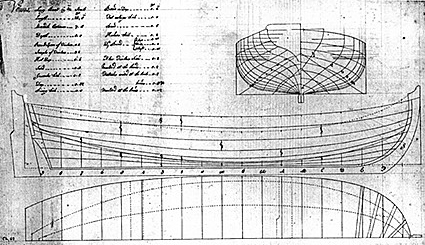
Longboat plan for frigate Venus 1728
Longboat houses have been driven to the point of extinction because when RNLI took over rescue responsibilities from HM Coastguards a radically different type of boat was introduced. This was the “self-righting” life boat with flotation tanks in both bow and stern designed specifically for rescue. These came in different versions but had a minimum length of 32 ft. They were five to seven feet longer than the Coastguard Longboats (the Budleigh Salterton Longboat House has an internal length of 29ft).
Longboat Houses were already occupying the obvious sites. So most Longboat houses were gradually demolished to make way for the new pattern boats, others have presumably succumbed to development of their prime seaside locations. The RNLI introduced standardised lifeboat house designs with features that clearly distinguished them from the Admiralty boathouse they replaced. For example many had extended eaves to the roofs under which the volunteer boatmen could dry their kit. Budleigh Salterton never had an RNLI station.
The lack of good documentation of Coastguard Stations and their operations can be explained by its “Cinderella” status within the Admiralty, a function of the tensions between the service and the local communities. Personnel retention rates were low and desertion rates high. In modern time the Coastguard Museum has been housed in Brixham and then Bridlington but has been defunct with whatever archives it possessed since 2007/8.
End of a coastguard presence
So far it has not been possible to piece together the end of the story. Photographic evidence shows that the Longboat House was no longer operational and become a beach café in the 1920’s, but practice firing of the rocket apparatus was still taking place in living memory (1950’s). This took place across the Otter mouth and the white wooden post on the headland of the Eastern bank, used to anchor the rocket fired line, is clearly visible in photographs of the Otter Head up to the 1970s. Local boys were then carried over the river by breeches buoy slung from the line. The breeches buoy is now in the possession of Fairlynch Museum. Given the mobilisation of the Coastguard in 1914, it is likely that they were partially or wholly replaced by auxiliary personnel. Little seems to be known of the role played by the Coastguard or auxiliary Coastguard locally during WWII or the date of final disbandment of the Budleigh Salterton Station and it is a matter of ongoing research.
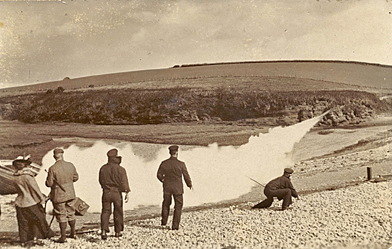
Rocket practice
Addendum 2013
A notice of the sale of the leases by the Admiralty of both the boathouse and the boatmen’s cottages (but not the chief or petty officers quarters or the watch house) has just been discovered (9). The sale by Crews and Son in conjunction with Mr J Palmer was scheduled for 11 October 1927. The details in the notice unequivocally show that the 99 year leases for the boathouse and the coastguard complex on the hill above had the same expiry date of 25 December 1967 i.e. were bought by the Admiralty from the Rolle Estate at the same time. This sale also dates the conversion of the boathouse to café to 1927/8, consistent with photographic records.
Researched and written by © David Daniel, 2011
References:
1.“Coastguard! - an Official history of HM Coastguard”, William Webb, HMSO 1976. ISBN 0 11 510675 8
2.OVApedia article by Gerald Millington “Smuggling” OT-G-00005
3.Article by the UK Tea Council on Tea Smuggling www.tea.co.uk/tea-smuggling
4.Fairlynch Museum
5.Exeter Flying Post 11 Jan 1787
6.English Heritage listing report, Case UID: 168954, 28-JAN-2010
7.Mark Rolle - His Architectural Legacy in the Lower Otter Valley, Alan Ford, Otter Valley Association © 2002, ISBN:0-9507534-5-9.
8.E-mail correspondence with Tony Pawlyn, National Maritime Museum, Falmouth, Cornwall, 21/8/1010.
9.Notice of sale by Crews & Son 1927, Fairlynch Museum
BS-G-00010 any