
Ovapedia search :
Title:
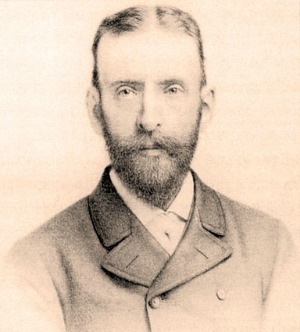
When Mark Rolle (see note1) appointed Lipscomb as Steward in 1865, he was 31 years of age but already an experienced land agent. It is obvious from the style of his letters that he had been well educated. The details of his professional training are unclear, but he was certainly country-bred. His father was Rector of Welbury near Northallerton in Yorkshire.
In articles written in later life entitled “Old Hints to Young Land Agents”, he says, “I suppose that even when quite a lad I knew I was interested in numbers of the rents paid in that district and their rates per acre. I then spent several years in the county which I should recommend almost before any other county as a tuition ground for agency . . . in Northumberland, and there I had, and took, abundant chances of learning the value of properties and of individual fields.” In one of his letters, he refers to being with Sir Walter Trevelyan’s Agent in Northumberland.
He goes on, “From thence I got my first agency in a stonewall county.” This was probably Yorkshire since, in another letter about a possible reading room and library in Otterton, he writes, “In a village in Yorkshire, I nearly ruined the Public House by establishing a cheerful well-lighted room which was open nightly from 7 till 9.30.” Elsewhere, he refers to four years spent in Scotland as Factor of an estate in Ross-shire, so he had much and varied experience before he came to Devon.
He is silent on whether he had attended Agricultural College, as recommended in “The Book of the Landed Estate” published in 1869 by Robert Brown. However, few land agents at that time would have had this opportunity as the only one, the Royal College at Cirencester, did not open until 1845 although Edinburgh University ran a course in Agriculture. He writes of his “tutor”, probably an established land agent to whom he was an assistant. He himself had pupils in his time. In any event, he would have studied books on land agency, as Brown’s treatise was by no means the first on the subject. The Estate Archives contain a copy of “British Farming” by John Wilson published in 1862. At about this time, the same publishers issued “Elements of Agricultural Chemistry”.
As Steward, Lipscomb lived at Syon House with his wife and children, and three servants. On a salary of £500 a year, he was comfortably off, and he and his wife were both prominent in the local community. He served as Churchwarden at All Saints, East Budleigh and was active in the management of the local schools.
Apparently he started as Steward for the South Devon Estate only, but in 1875 took charge of the North Devon Estate as well. Although he made lengthy visits in the north, he must have had a permanent deputy there.
He held the post of Steward for the Estate for 27 years before retiring because of ill health at a comparatively early age. During those 27 years, he oversaw momentous changes on the Estate as farm sizes were increased by amalgamation, and new farms and cottages were built.
He was eager to raise the standard of farming on the Estate and floated a scheme to send tenants to study the superior methods favoured in Northumberland and Lothian. He persuaded Mark Rolle to offer a cup to be presented annually to the tenant with the tidiest farm of more than 100 (later 50) acres.
He became sufficiently well known and respected in his profession to be called in 1881 to give evidence, as one of the few witnesses from the south-west, before the Royal Commission on Agricultural Depression chaired by the Duke of Richmond.
Old Hints to Young Land Agents
He was also asked to contribute a series of articles to the monthly “Land Agents Record” in 1889 and 1890. These articles were entitled “Old Hints to Young Land Agents”, and are a delight to read. Lively, witty and shrewd, they give a flavour of the man’s character, which can also perhaps be read from his portrait, and is certainly confirmed by his letter books.
“Old Hints” give a fascinating insight into his methods, and some idea of the great scope of the responsibilities of an agent, who, provided he stood well with his principal, had immense authority on his estate. It is impossible to pass by these articles without indulging in a few quotations, from which we can learn something of the nature of his work in his own words.
On Relations with his Principal: “Let me impress upon the young agent with my utmost earnestness to be perfectly frank and above board with his chief. If he has the ill-luck to make some miscalculation or mistake, and has either wasted some money in some unsuccessful venture or experiment, or, what is more likely, has allowed some specious rascal to get on his blind side, let him be the first to let his chief hear about it, and all about it. Never, under any circumstances, leave anything to be found out against you; never understate any loss, failure, or bad business of any sort. If you don’t entirely trust your chief, how can you expect him entirely to trust you?”
On the Use of Estate Staff: “Young Agent may take my word for it that, if success attends his efforts, he can no more depute the real brain work of his business to underlings than a successful painter or lawyer can do so. Book-keepers, surveyors, plan drawers, shorthand writers, clerks of works, foresters, bailiffs can all be got by the score at £100 a year salaries, but they are all tools in the agent’s hands. If they are tools that think for him, as well as carrying out his instructions, they are of double use to him and are worth double pay, and are cheap at the price.”
On the Right Use of Time: “Remember that an agent’s life above all others, a parson’s included, may be a very busy one, or the reverse, just as he himself makes it. Nothing is easier than to throw plenty of cold water on proposals which would benefit your charge and enhance its value, but which would give you a lot of personal trouble. Nothing is easier than to let things slide.”
On Farm Tenants: “Young Agent must take care to make himself accessible to farmers and to business callers generally. On at least one day in each week, he ought to be “at home”. What can be more trying than for a man to ride or travel many miles for an interview only to be disappointed? and “If any request is simply ungrantable, tell your man so plainly. Never let a man go away with the hope that you are going to say “Yes” when you are inwardly resolving to write him a decided “No”, for that is simply moral cowardice.”
On Repairs: “In Utopia, if estates do not manage themselves, agents will, I take it, be relieved from all anxiety on the subject of repairs; for if there is one enemy who can never be subdued in this work-a-day world on which we agents exercise our calling, it is the enemy of decay.” And “If the young land agent escapes with one letter or call per month from tenants of gentlemen’s houses let under yearly tenancies, he may think himself lucky . . . Don’t I see in my mind’s eye, when I show myself on any public occasion, my gentleman tenant spot me, edge round me, descend upon me with affected surprise, and remark on the weather, and then, after a very short pause, comes the “Oh, Mr Victim, it seems a shame to bother you with business here, but (the inevitable but) I do wish you would come and see how my dining-room chimney smokes” or “how my drawing-room wall is showing damp” or “what a suspicious smell there is, etc, etc.” He always wants you to go and see his particular want personally, too, and why I never can tell, unless he thinks that you, as “boss”, can lay your hand upon the place and cure it then and there. On the other hand, the patience of the cottager class under neglect, inconvenience, and even danger, is often beyond belief. “Us aren’t been able to apse up the front door night-times, more than a year, but us don’t take no notice o’ un. Who’d a think of robbing the likes o’ we?”
On Valuing Property: “I know that some people imagine that you might take a valuer 100 miles blindfold, drag him out of a train at a country railway station, and that he would be quite able to start off in any direction and value a farm, field by field, and, at the end of his inspection, name a fair rent then and there. My impression is that Mr Valuer, however experienced, would under those circumstances act very much as a liberated pigeon would under similar circumstances, and take his bearings very carefully indeed, and do a great deal of “circling” before taking any decided action. Some people imagine that valuers carry spades with them, and dig into the soil in order to see what it is like! Such a thing might be resorted to if the ground was covered in snow. I never saw a valuer do such a thing, and in my opinion, a valuer must be a poor one indeed if the eye of experience could not see much deeper than he could dig.”
On the Profession: “Do what you can to elevate your profession. It is an honourable one. There is nothing in the work which is expected of us which need in any way be galling or lowering to a man of honour . . . Our power for good or evil in this world’s affairs in a countryside is enormous. You may do much, very much, to make many hundreds of people of all grades prosperous and contented, or the reverse . . . I thank God that I am what I am. And if you are a lover of nature as well as of your work; if every bird and beast of the field, every flower of the hedgerow, every change of the developing season, every geological change on your charge, and all that such change brings with it, have an interest for you, and if your barometer, thermometer and rain-gauge have the same; if you are blessed (great blessing) with a cheery manner and a faculty for setting people at their ease and drawing them out; if you can throw off the vexations of your life as a duck does the water from its back, and if you have a receptiveness for all that is original and humorous, how can your life ever be dull? How can it be otherwise than full of interest, and therefore of happiness? But far and away above any satisfaction of this kind . . . is the inward knowledge that you can look the whole world in the face and say that you have done your duty, and something more than your duty.”
The Letter Books
There writes a man supremely happy in his work, and his letters tell the same story. From these articles, and even more from his letter books, we get to know the man well. In his neat handwriting, he filled 29½ letter books with copies of his letters. All but one of these are in the Rolle Estate Archives; unfortunately the first book is missing (since discovered and returned in 2008). Each volume contains about 1,600 letters, close to 50,000 letters in all.
The letters range widely over all manner of subjects – letters on expenditure, on the repair of properties, on building new farm buildings and cottages, letters to Mr Forster (Mark Rolle’s solicitor in London) for advice on legal matters, letters on tenancies and rents, on valuations, on letting land for building in Budleigh Salterton and Exmouth, letters on bricks and timber, letters to the forester and the bailiff of the Home Farm. Last but not least, there are highly diplomatic (but never obsequious) letters to the formidable Lady Louisa Rolle (1) written in the third person. “Mr Lipscomb presents his compliments to Lady Rolle and begs to say . .”
In his industrious way, with good sense and touches of humour, he dealt with all manner of subjects, both great and small. Not the least of his concerns was the rabbit population. At one point, he became so exasperated with the farmers’ frequent complaints about the damage they caused that he burst out “I am sure that for my part I have every wish never to hear the subject of Rabbits mentioned again.”
He was to be disappointed. The rabbit problem was a very serious one. The Estate paid out hundreds of pounds to tenant farmers in compensation for damage caused by rabbits. The root of the problem was Lady Rolle, who apparently had a right to all the rabbits on the Estate. Her warreners however took no more than 20 or 30 rabbits a night which did little to control, let alone reduce, the rabbit population. There was widespread resentment among the tenants, made more bitter by the knowledge that Lady Rolle was actually selling the rabbits that fed so freely on their crops.
Eventually, Mark Rolle authorized his tenants to kill rabbits on their land. Lady Rolle was greatly displeased, and blamed Lipscomb. He defended himself by claiming that he had acted “in exact accordance with Mr Rolle’s instructions”. This was a trifle disingenuous of him since for some time he had been urging Mark Rolle to this course. But then Lipscomb, whom some accused of being a Radical, was far from popular with Lady Rolle, complaining “the manner in which Lady Rolle writes and speaks of me is what I scarcely know how to endure silently”. No wonder he ceased to have any direct communication with her, preferring to use Forster, the solicitor, as a go-between.
And all through the books, there are of course letters to his “chief”, reporting, seeking instructions, and even soliciting help for others. “Something turns up every day now for me to trouble you about. I am asked to entreat you to give an increased subscription to Exmouth regatta and athletic sports.”
An untimely end
It is a great pity that his Stewardship came to a sad and untimely conclusion when he was only 58. Near the end, his son Basil, already assistant Steward, took over much of his father’s work. In a letter of January 1892, he writes “The Doctors have ordered my Father, who has this week had a relapse, to give up all work and worry of every sort for at least three months. I therefore acknowledge your letter of yesterday’s date . . .and have not shown it to my Father as we have to keep all letters from him.”
Despite this, Lipscomb evidently rallied, for in March he wrote a long letter to Mark Rolle in which he urged his chief to carry on the “good work” of improving the farms and cottages on the Estate “until the work is completed”.
At about this time, he took himself off to Madeira in hope of recovery from what he described as “congestion of the liver with complications”. He sent optimistic reports to his family but he died there on 18 May. The obituary in the East Budleigh Parish Magazine is such a moving tribute to the man that it is worth quoting in full.
“One of the widest known and most esteemed of our parishioners has, in the Providence of God, been called away to a better world. The familiar face, the animated manner, the eager spirit of ROBERT HARTLEY LIPSCOMB will long be remembered by old friends here, and in almost every home standing on the extensive Rolle Estates, both in North and South Devon. Those who knew him best knew well what a gentle sympathetic heart he possessed, and all can testify to his unswerving devotion to duty, his indefatigable industry and his loyalty to those whom for 27 years he here so faithfully served. But incessant work, and the countless responsibilities incident to his position told on a constitution not naturally strong, and after six month’s illness, borne with Christian bravery and patience, in which he never altogether lost his winning cheerfulness and brightness, he peacefully entered on his rest on Wednesday, May 18th, in the 59th year of his age. He will be sorely missed and his memory will long be cherished with affection by the large circle of friends and acquaintances, which seemed to widen indefinitely with increasing years. He will be remembered as a faithful steward of upright purpose and integrity, a generous and kind friend to all, a man of the widest sympathies, a charming companion, a devout Christian, and a loyal Churchman. The writer might say much more out of a full heart, but will add only this of him; that the better he was known, the more he was loved.”
To sum up his Stewardship of the Estate, one can do no better than to quote Mark Rolle’s tribute to him. “His services on behalf of my property I can never sufficiently acknowledge.”
(Note1. OVApedia article “Short history of the Rolle & Clinton Devon Estates” by Gerald Millington, 2006, gives an explanation of the relationship between these two estates, Hon. Mark Rolle and his aunt, Lady Louisa Rolle.
Written by Alan S Ford MA, FRIBA, extracted from: Mark Rolle - His Architectural Legacy in the Lower Otter Valley, Otter Valley Association © 2002, ISBN:0-9507534-5-9.
Source:
Clinton Devon Estate archives
129 EB-B-00005 Biography, Agriculture, any