
Ovapedia search :
Title:
Hugh Bowring Mulleneux and his wife Mabel came to live at Beechcroft, 6 Cliff Terrace possibly in1935. Hatchard-Smith had designed the house and the Mulleneuxs are listed in the telephone directory at the house in 1936. Hugh lived there until his death in February 1947.
Hugh was born in 1878 in West Derby in Liverpool in 1878. He joined the Navy in 1891 on the training ship HMS Britannia at Dartmouth. This consisted of two hulks moored together on the river – the present-day college was opened in 1905. Cadets were allocated to a term for two years training after which, if their enthusiasm and behaviour had been good, they entered the navy as midshipmen.
Mulleneux joined the battleship HMS Anson as a midshipman in October 1893 and remained on her till April 1896. Anson was part of the Mediterranean Fleet. As seemed to be the case with young naval officers Hugh was moved around at regular intervals and his early moves were:-
From May 1896 to May 1897: to the corvette HMS Volage which was part of a training squadron.
January to March 1897: he was lent to the battleship HMS Colossus (also in the Mediterranean Fleet) as an acting sub-lieutenant and was confirmed as a sub-lieutenant while in the post.
Briefly in early 1898 he was at the Sheerness shore-establishment HMS Wildfire and the destroyer HMS Snapper the base ship, before a transfer in May 1898 to the battleship HMS Hannibal part of the Channel Squadron. He stayed until October 1899. He was promoted to Lieutenant in October 1890 and posted to the newly built cruiser HMS Hermes which was being commissioned to join the North American and West Indies Station. He did not however sail with the ship because he went on sick leave in November 1899.
When he had recovered he was posted in April 1900 to the newly built cruiser HMS Argonaut at Chatham. This was being commissioned for service on the China Station and sailed in May. During the tour of duty (1900 until 1904), the Commanding Officer, Captain George H Cherry RN, issued some 600 punishment warrants, gaining a reputation as a stern disciplinarian. As a consequence, the ship's officers ordered medals to be struck by Gamages of London as reward and mementos of their service under such a captain (1). Hugh left that ship at the end of December 1900 whether under a cloud or not is not clear.
In May 1901 he was back on HMS Anson for 5 months on coastguard duty before being posted briefly to the battleship HMS San Pareil which was the Sheerness guard-ship before returning to Anson at Queensferry for a tour of duty ending in September 1902. During this posting he was lent in February to Rear Admiral Walker on HMS Resolution as his Flag Lieutenant. In September 1902 on leaving Anson he was sent to HMS Victory which was being used for signals training.
In March 1903 he was briefly posted to the yacht Victoria & Albert before moving in June to the battleship HMS Magnificent, part of the Channel Fleet, as Flag Lieutenant to Rear Admiral Hon. Hedworth Lambton, where he stayed for a year. In June 1904 he moved to the battleship HMS Victorious to be Flag Lieutenant to Rear Admiral F C B Bridgeman who had replaced Lambton as Second in Command of the Channel Fleet. In October he left Victorious for Vernon 111 for instruction in wireless telegraphy. Vernon 111 was a shore-station and was one of several hulks moored together in Portchester Creek.
In November 1904 he reported to HMS Bacchante to rejoin Rear Admiral Lambton as his Flag Lieutenant. Lambton was commanding the Mediterranean Cruiser Squadron.
In January 1907 he was posted as a staff member to the Signals School on HMS Victory, and later that year he was temporarily attached to the staff of the Commander-in-Chief Home Fleet.
For two years he was Flag Lieutenant again to Sir Hedworth Lambton who was Commander-in-Chief of the China Station.
In May 1910 he was put in charge of the Chatham Signal School and shortly afterwards at the end of June was promoted to Commander. This may have precipitated the next important event in his life when in Dover on 17th August he married Miss Mabel Josephine Hubback. They had a son, Hugh Hedworth Hubback Mulleneux in 1911, and he followed his father into a career with the Royal Navy.
In August 1912 Mulleneux was appointed to the command of the destroyer HMS Zulu and stayed until May 1914 (2). According to Wikipedia, Zulu was part of the 1st Destroyer Flotilla of the Home Fleet. She remained part of the 1st Flotilla until 1913, when she transferred to the 4th Destroyer Flotilla, based at Portsmouth. In February 1914, because her range was too short for effective open sea operations, she was sent to Dover, forming the 6th Destroyer Flotilla which became the Dover Patrol during WW1. He moved from Zulu to commission the new destroyer HMS Llewellyn launched the previous year, and he was also in command of a division of the 3rd destroyer flotilla (3). In July 1914 war was declared on Germany. He left Llewellyn in August 1914 and was briefly back in charge of the Signal School at Chatham before moving in November to command the destroyer HMS Miranda for 5 weeks (2), and was then sent to Pembroke a shore barracks at Chatham to be attached to the staff of the Commander-in-Chief at the Nore Sir George Callaghan.
He stayed as a staff officer for the rest of the war having various duties. Admiral Callaghan wrote in his service record - “has been of much assistance to me as Intelligence Officer; a most dependable officer with excellent judgement”. Callaghan had earlier in June & December 1916 recommended him for promotion and also commented on him being an excellent French speaker. Callaghan also recommended him for appointment to the War Staff and this took place in January 1917. He was made an Acting Captain in December 1917 and was Chief of Staff to Vice Admiral Grant, Commander-in-Chief North American and West Indies Station.
In 1918 he was sent to Washington USA as Liaison Officer in the Convoy Section of the US Department of the Navy. He seems to have been very tactful in his dealings with the Navy Department and they expressed “appreciation of the manner in which he discharged his duties...with utmost zeal and the greatest ability in his sometimes difficult and complicated and strenuous work”. He was sent home in December 1918. After the War in April 1919 Hugh was to receive a C.B.E in recognition of his work in Washington and for valuable services as Chief of Staff to the Commander-in-Chief, North America and West Indies Station.
At his own request he was placed on the retirement list in July 1919. He was promoted to Retired Captain in January 1923 (4).
After his retirement the family lived in Shanklin and Hugh was actively involved in local affairs. He was a member of the Urban District Council until the end of November 1925 when he resigned as he was leaving the town (in 1926). He had also been Treasurer and then Vice Chairman of the local branch of the British Legion and he apparently donated the land on which the club premises were built (5). He was an enthusiastic cricket player and Chairman of Shanklin Football Club. He and his wife moved to Sandhurst in Berkshire where they lived for about 10 years before moving to Budleigh Salterton.
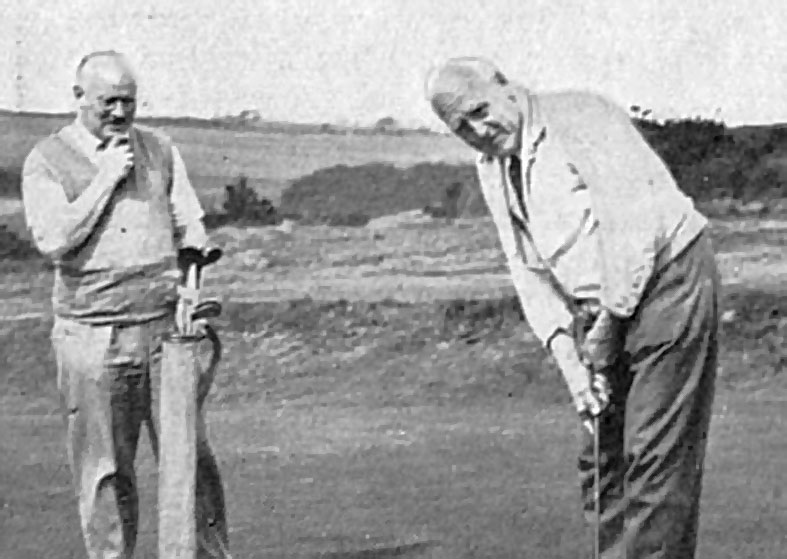
Captain Mulleneux & Major Stuart Hamilton (6) picture from The Bystander 08 June 1938.
In Budleigh he was an active member of the East Devon Golf Club and after several years on the committee was the Club Captain in 1947 (the year he died). During WW2 he volunteered as a Special Constable. The London Gazette of 22nd August 1944 records that he was awarded The Order of Polonia Restituta Third Class for services to the Polish Navy by the President of the Polish Republic. Three destroyers of the Polish Navy and two submarines had escaped to Britain in 1939 and were supplemented with leased British ships, including two cruisers, seven destroyers, three submarines, and a number of smaller fast-attack vessels and they fought alongside the Royal Navy (1). Captain Mulleneux must have been sent by the Admiralty to help integrate them with our navy (perhaps with advice on communications).
Hugh died in February 1947 and his wife in 1969 in East Sussex.
Roger Lendon ©2018
(1) Wikipedia
(2) www.dreadnoughtproject.org/tfs/index.php/Hugh_Bowring_Mulleneux
(3) Army & Navy Gazette 26 Dec 1914 (however some of this account is at variance with information in (2).
(4) 1924 Navy List.
(5) Portsmouth Evening News 21 April 1934.
(6) Hamilton, Major Stuart OVApedia October 2016
Other sources: www.ancestry.co.uk & Navy Records at www.findmypast.co.uk.
BS-B-00086 Biography