
Ovapedia search :
Title:
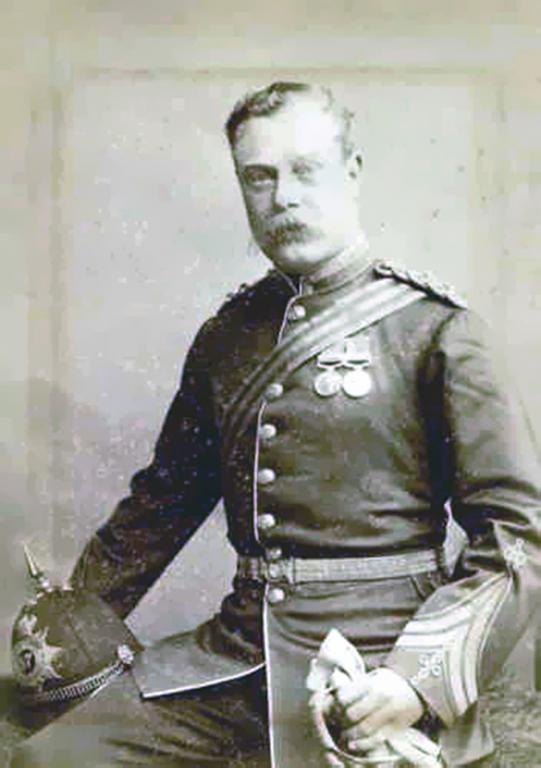
Major Hinxman appears in the Directories for the town living at 3 Westbourne Terrace between 1883 and 1893. He died in the Stockport area in 1894. He was born on the 23rd May 1844 in Lancashire the eldest son of Henry James Hinxman and his wife Betsey (nee Hamer) who were living in Manchester Road, Bury. His father was medical officer of the Bury Union Work House and a local surgeon and licensed apothecary. He was unfortunately declared bankrupt in January 1850 (1) and a dividend was paid to creditors in December 1850; he must have been released from bankruptcy some time afterwards. Before 1855 the family appear to have moved to live near Victoria Park in Manchester because that is given as his address when he passed the examination to become a licentiate of the Royal College of Surgeons (2); but they appear then to have moved to Kent as their daughter Harriett was born in the Lewisham registration district (probably Blackheath) in the early part of 1855. Henry James practised medicine locally (3).
In 1864 Henry Charles was bought a commission as Ensign in the 1st Battalion of the 10th Regiment of Foot (North Lincolnshire Regiment). This was stationed in Dublin, but in September 1864 his battalion moved by train north to embark on the transport ship Mary Shepherd from Kingstown en route to the Cape of Good Hope (4). By 1867 he had been promoted to Lieutenant on merit.
The Battalion was in Yokohama in Japan between 1868 and 1871 where they had the job of protecting the small foreign community (5). He appears to have then returned to England before again being posted to his Battalion headquarters in Ceylon.
The Battalion served on the Malay Peninsula from 1874 to 1876 and they took part in the misnamed Perak Campaign, (most of the action being well away from Perak). Henry excelled himself during the campaign and was mentioned in the Times and Straits Times newspaper accounts. Lieutenant Hinxman was in command of a small force which attacked the stockade village of Paroa in the Sunghie Ujong region when they routed 6-700 Malays with a force about a tenth of that size. This action was later described as “the sharpest fight of the war” (6).
In June 1876 Hinxman arrived back in Portsmouth in the troopship HMS Himalaya after his tour of duty in Malaya but in August he had to return overseas because he was promoted to Captain (7) and to the command of a Company in the 57th Foot (1st Battalion, West Middlesex Regiment) which at that time was in Ceylon. His exploits in Malaya were cited as one reason for his promotion.
In February 1879 the Regiment received orders to sail to Natal to the Zulu War, and they embarked on HMS Tamar in Colombo, reaching Durban on the 11th March. They joined up with a force commanded by Lord Chelmsford that was going to relieve Eshowe which was besieged by the Zulus. Hinxman was in a column that took part, in a battle at Inyesane where he was slightly wounded (8), and then with his regiment in a major battle at Gingindlovo on the 2nd April when the Zulus attempted to prevent the relief of Eshowe.
One account (9) describes how Chelmsford had situated his camp (laager) at Ginginlovo on a 300-foot high ridge. The ground sloped away in all directions, allowing a good field of fire. A trench surrounded a waist high wall of earth, which itself encompassed 120 wagons formed a square with sides of 130 yards in length. The corners of the square were reinforced by Gatling Guns, regular artillery and rocket launchers. The 57th occupied the right face of the square. At daybreak, Chelmsford sent out the Natal Native Contingent to provoke the Zulus into an attack while he held a strong position. The Zulus duly obliged and at a range of between 300 and 400 yards the British infantry opened fire, supported by Gatling guns and rockets. The 57th Regiment wasn’t apparently fully prepared for the attack as the men were getting their breakfast at the time but soon got into position.
Zulu marksmen caused a few casualties within the laager, but the defenders kept the Zulus at bay. Although the Zulu regiments made persistent rushes to get within stabbing range, their charges lacked the drive and spirit that had pushed them forward at the Battle of Isandlwana and Rorke's Drift. After 20 minutes, the Zulu impi began to crumble away. Seeing this, Chelmsford ordered pursuit by the mounted troops and the native contingent. Large numbers of Zulu warriors were killed in this chase. By 07:30am, the Zulus had fled. Around the laager itself, 700 Zulu bodies were counted and 300 more were killed in the mounted chase of the retreating warriors. The British sustained eleven dead, including a Lieutenant-Colonel, and 48 wounded. One of the wounded was Captain Hinxman. He had apparently killed two Zulus with his sword before receiving a bullet in the leg. The sword was kept for many years in the Regimental Museum. His wound was said to be slight in the Commander in Chief’s report but it was obviously more serious as he was repatriated to Portsmouth on HMS Orontes, arriving on the 10th July. He was sent to Netley Hospital. He had in fact received a round shot in the back of his right leg which damaged his fibula, and he had 10 fragments of bone removed (10).
In September 1880 he received orders to go to the Regimental Barracks in Hounslow for a two year posting, however, (perhaps because of his injury), he doesn’t appear to have completed this posting because in the 1881 census he is in residence at Anglesea Barracks in Portsea.
In January 1882 he was promoted to Major but this was rescinded in April1893 “under the provisions of Article 34 of the Royal Warrant of March 11 1882” (11). Article 34 concerned promotions received while seconded to the Auxiliary Forces. The Army might have wished to avoid promoting officers who were not active in the Regular Army. This suggests that Henry may possibly have either been on sick leave or in charge of an auxillary force. In May 1884 the London Gazette records that he retired from the Army with the honorary rank of Major. As he appears in the town directory for Budleigh Salterton in 1883 it is likely he had been non-active for a while before his official retirement. It is also likely that his unmarried sister Harriett Marshall Hinxman had come with him as housekeeper as she appears with him in the 1891 census return for 3 Westbourne Terrace.
Henry doesn’t appear to have been particularly active in town affairs. He did attend a rather rowdy meeting held in the Assembly Rooms in September 1885 to support Sir John Kennaway’s candidature in the Parliamentary Election; the disruption was caused by a group of ultra-radical people from Exmouth that the Chairman General Goodwyn had difficulty controlling (12).
In November 1885 a War Office notice in the London Gazette stated that “Capt. and Hon. Major Henry Charles HINXMAN, late Middlesex Regiment, has been permitted to commute his retired pay”; in other words he took some of his future pension as a lump sum. This may suggest that he knew that he was unlikely to have a long life and in fact he died at the relatively young age of 49 in the Stockport area in 1894. His sister also died young at the age of 42 in Derbyshire in 1897.
Researched and Written by Roger Lendon © August 2015
(1) Yorkshire Gazette 12 January 1850
(2) Morning Post, London Tuesday 25 December 1855
(3) 1861 census
(4) Enniskillen Chronicle and Erne Packet Monday 19 September 1864
(5) Royal Lincolnshire Regiment article on Wikipedia
(6) Straits Times Overland Journal 22 Feb 1877
(7) London Gazette
(8) Harts Army List 1894
(10) Saturday 12 July1879, Edinburgh Evening News
(11) London Gazette
(12) Exeter and Plymouth Gazette 30 September 1885
BS-B-00073 Biography