
Ovapedia search :
Title:
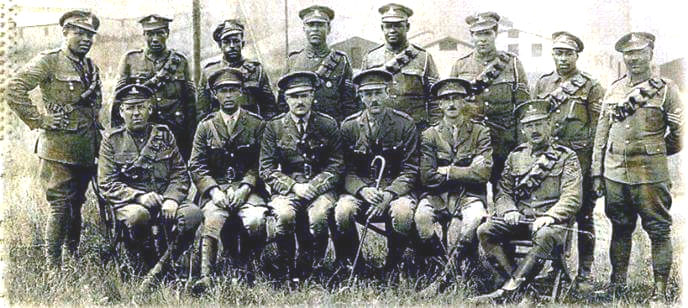
Officers and NCOs of Bermuda Contingent, Royal Garrison Artillery, who served in France and Belgium in World War 1. Photographed in England prior to their departure to the front. British Army photo. (Major Hamilton is third from the left in the front row.)
Major Hamilton lived in Budleigh Salterton from about 1921 until his death in 1940 and his wife remained in the town until she died in 1973 (1).
Stuart Hamilton was born in Stamford, Fairfield, Connecticut in May 1888. He was the second son of Frederick Hastings Hamilton and his wife Katherine Walton Woolsey (2). His mother died shortly after he was born and his father later moved to Bermuda. He remarried a French lady called Eugenie Hazenet Ligerot (1862 – 1952) and they had one son Frederick Ligerot Hamilton who became a photographer.
Stuart was obviously keen to see The World and when he was 20 he was in Japan and applied on 23rd March 1908 for an American passport because he intended to “travel in Russia”. He declared that he had left the United States on 7th December 1907 and that he would be returning there after 3 months. He gave his address as Dobbs Ferry, New York. Other interesting information in the application was that he was 5 foot 8 inches in height and had brown eyes and hair.
In May 1910 Stuart’s father Frederick died suddenly at his home in Paget parish, Bermuda. The name Paget is of interest as will become obvious later. In September 1912 Stuart married Gulielma Earl Davis in Bermuda. She had been born in Philadelphia, Pennsylvania in 1890. Their first child, Katherine was born in Bermuda in June 1913 followed in 1915 by another daughter Elsie and then their son Stuart in 1916 (3). A further daughter, Caroline, was born in Bermuda in 1920 and died in Budleigh Salterton on the 11th January 1922 aged 18 months and was buried in St. Peter’s Burial Ground.
Hamilton joined the Bermuda Militia Artillery as a 2nd Lieutenant in June 1913 and was made a brevet Lieutenant in March 1916 (4). Around this time members of the Bermuda Militia were called for service in France and Stuart left with the first contingent in May 1916, now, it would appear, with the rank of Captain. In France they were attached to the Royal Garrison Artillery (5) and went straight into the action at the Battle of the Somme between June and December 1916. Because the Bermuda Militia contained a mixture of black officers and men they were not allowed to fight at the Front and were used mainly in support roles (the same was true for the West Indian Forces). They were employed at the heavy ammunition dumps to store and deliver ammunition to the guns at the front. Much of their work was done under German sniper and shell-fire.
By early 1917 they had been moved to labouring work at the docks and later were attached to the Canadian Corps, serving with them at Vimy Ridge. They then were present at the Battle of Passchendaele from 24 June to 22 October where they had 3 men killed and several wounded (5).
At some stage Stuart was promoted to Major which must have been before the unit returned to Bermuda in July 1919 because the Bermuda Militia had been disbanded at home at the end of 1918.
After the war the family moved to Devon, possibly initially to Sidmouth because a Major Hamilton took part in a sports day organised by the Sidmouth Old Comrades’ in August 1920 (6). He entered the 100yds veterans race (for the over 40s) but didn’t occupy any of the first 4 places (newspaper comment being, “Major Hamilton also ran in this race”).
He probably was residing in Budleigh by 1921 as a Major Hamilton attended the funeral of Sir Archibald Alison in November of that year (7).
He was obviously an active member of the East Devon Golf Club being mentioned in occasional newspaper accounts from 1923 through into the 1930s. Also in 1923 we find him attending a ceremony at the Masonic Lodge in Budleigh; he doesn’t seem to have joined the Lodge by that time because he is recorded as a member of the Atlantic Phoenix Lodge of Bermuda. Where he and his family were living in the town is not clear, they may have been back in Bermuda for some of the time, but when he applied for his WW1 war medal in February 1925 he gave his address as Penlee. In November 1924 he applied to the Town Council for permission to build a detached house on a site in Westfield Road (8). He wanted to know whether he could have a thatched roof. It was obviously allowed because the house was built and is still thatched. In 1926 when the family moved in they called the house “Pagets” which is still its name (vide supra – his father died at Paget Bermuda).
The present owner Mr Jeremy Robinson tells me that the house was built from a design by J C Palmer. He gave me the following information: “ Much of the information about the Hamilton’s involvement with the building of Pagets came to us from the foreman builder, Mr Searle, employed by Palmers the Builders, who by 1972 was retired, and lived in the house next door to Pagets (he divided it into two – Lawns and Number 11b Westfield Road). It seems that in 1926 Palmers had an arrangement with Lord Clinton whereby they took an option on various sites around the Town and offered them for sale in a package including a house selected from a range of sizes and styles. They would pay Lord Clinton for the site when they concluded the eventual sale of the completed house. They selected our site and house style, although, according to Mr Searle, the original plan was for the roof to be tiled. In the event the Hamiltons returned from Bermuda when the house was in the course of construction and arranged for it to be thatched”.
In 1928 Stuart was sworn in as a member of the Grand Jury for the April Devon Quarter Sessions at Exeter Castle (9).
In April 1940 Stuart and Gulielma’s second daughter Elsie married at the Roman Catholic Church in Budleigh to Henry Revell Philips, a solicitor from Shropshire. The Exeter & Plymouth Gazette recorded that at the time she was the holder of the Devon County and the Exmouth tennis championships. Her bridesmaid was her young sister Brigid (who had been born in Budleigh in 1934 and named Irene Brigid). Stuart gave the bride away but this was one of his last important acts because he died in Budleigh Salterton Cottage Hospital on the 29 June 1940. It is possible that Stuart was to be an Aide de Camp for the Duke of Windsor when he became Governor of Bermuda (10) but as that didn’t take place until August 1940 he never fulfilled the role.
Gulielma apparently rented out the house after her husband’s death during the latter part of WW2, some of the occupants being the parents of the young Richard Rodney Bennett. She continued to own the house till her death in the St. Cecilia Nursing Home in 1973.
After her marriage, Stuart and Gulielma’s daughter Elsie moved to Kent and died in Tunbridge Wells in 1985. The eldest girl Katherine Jean Hamilton went to Quebec in 1939 and died on 7 Mar 2003 in Gladwyne, Montgomery, Pennsylvania (3). Daughter Irene married Timothy J Crick in 1958. Jeremy Robinson tells me that she and her sister Elsie interviewed prospective buyers when their mother’s house was sold and the Robinsons were the successful purchasers “because they were the only ones who had children”.
Son Stuart was probably initially educated locally but then attended Downside School from 1930 to 1934. He joined the Portsmouth Division of the Royal Marines in January 1935 as a probationary 2nd Lieutenant and won the Sword of Honour as the best young marine officer of his year (11). By the time of the 1937 Navy List he had progressed to probationary Lieutenant and then later in December was confirmed as a full Lieutenant backdated to May. In June of 1937 he had been appointed to serve on HMS Warspite (12). His entry in the Navy Lists indicates that at some stage he took and passed a course in anti-aircraft artillery. In May 1940 he was made an acting Captain and was serving with the Royal Marine Naval Base Defence Organisation (MNBDO 1) where I believe he stayed until they were disbanded in 1944. I’m not sure where his anti-aircraft battery was stationed. In 1941 he had been created acting Major which probably means he was then raised to Battery Commander because in the 1941 Navy List he was Battery Commander for “D” Battery.
In April 1944 he had to relinquish the rank of acting Major presumably when the MNDBO1 force was disbanded, but then in May he was reappointed to the same acting rank. He retained the rank until October 1948 then reverted to Captain; he finally became a substantive Major in December 1949. In the 1948 Navy List Captain Stuart Hamilton has p.s.c. after his name which “denotes an officer who has qualified at the R.N. Staff College or who has served for a period of 6 months or more on the Directing Staff”.
In 1951 he left the Service and joined a trading company in Mombasa and then moved to Nairobi as the East Africa Managing Director of the company (11). He and his wife Eileen ended their lives in Malta where they were both members of the Military & Hospitaller Order of St. Lazarus of Jerusalem. He was appointed Commander and Grand Knight of the Supreme Council, and his wife was a Dame of the Order. He died in Vittoriosa in June 2002 and his wife died in February 2009 at the Casa Antonia nursing home (13).
Written and Researched by © Roger Lendon, October 2016
(1) Town Directories and BT phone books.
(2) http://www.tmason1.com/pafg1416.htm
(3) Ancestry.com Public Trees
(4) https://www.forces-war-records.co.uk/
(5) Wikipedia
(6) Friday 06 August 1920, Western Times
(7) See OVApedia entry on Baker, lt. Col. louis and Samuel Hyde
(8) Friday 21 November 1924, Western Times
(9) Friday 13 April 1928, Exeter and Plymouth Gazette
(10) Personal communication from Mr Jeremy Robinson
(11) “The Grand Priory of the Maltese Islands of the Military & Hospitaller Order of Saint Lazarus of Jerusalem. A historical review.” Chev. Charles Savona-Ventura 2009
(12) Wednesday 2 June 1937, Portsmouth Evening News
(13) www.timesofmalta.com/articles/view/20090208/social/announcements.
Biography BS-B-00076