
Ovapedia search :
Title:
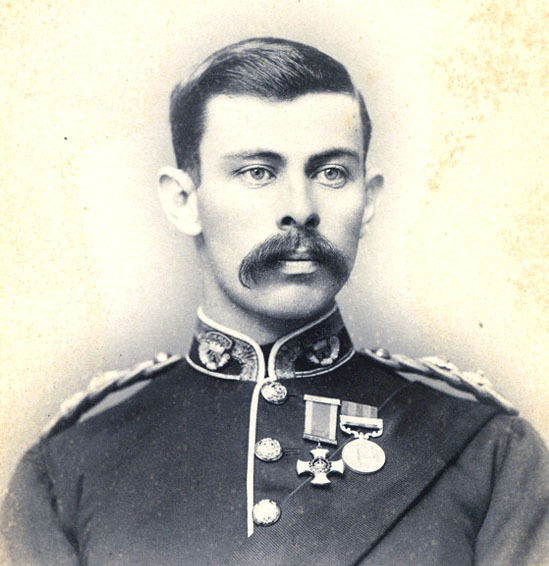
George Henry Holbeche Couchman and his wife Helen came to live at “Hedges” in Sherbrooke Hill in 1926 and he lived there until his death in 1936. He was born in Madras in 1859 eldest son of Colonel Edward Holbeche Couchman RA and his wife Federata nee Whitlock (who herself had been born in Madras). He was sent back to England to be educated at Haileybury College and in May 1878 was commissioned as 2nd Lieutenant in the 2nd Battalion, 13th Regiment of Foot (later Somerset Light Infantry) and joined the Battalion in India. He had progressed to Lieutenant by February 1880.
There is a detailed account of his military career in his obituary which appeared in the Somerset Light Infantry Regimental Journal in 1936:
"Colonel Couchman, known to his contemporaries in the Regiment as Box, was essentially an outdoor man and, in his young days, a noted big game shot. He was an enthusiast at all sport, especially polo and shooting. He loved, too, to wander and was never happier than when camping out in the jungles and forests of India and Burma. His love of this kind of life naturally led him into the Intelligence Branch of the Staff in India, and he did a good deal of survey work in Burma and later on in Bengal – and it was his work in the Intelligence Branch, in which he served as D.A.Q.M.G. (deputy assistant quartermaster general) from 1892-98 and as A.A.G. (assistant adjutant general) from June, 1900, to May, 1902, which brought him his Brevet-Lieutenant-Colonelcy. He commanded a Battalion of his Regiment – The Somerset Light Infantry – for the full term of four years, loved and respected by all, and was then promoted Colonel and given command of the South-Western Brigade (Southern Command) in June, 1910. He retired in January, 1914, after thirty-six years’ service. But this was not to be the end of his soldiering for, when the Great War broke out, he again went on Active Service and served first as a Brigade Commander in France and afterwards in a Staff appointment, gaining a Mention in Despatches, the 1914/15 Star, and the Great War and Victory Medals. After the war failing health obliged him to live a quiet and somewhat retired life, but he never lost interest either in his friends or his old Regiment."
During the Burma Expedition of 1885-87 he received two mentions in dispatches and was awarded the D.S.O. (which he is wearing in the attached photograph, plus the General Service medal with the clasp for Burma) (1), and was promoted to Captain in 1886. In 1890 he was given a job in the Intelligence Branch for India & Burma. He was DAQMG in Burma April 1892 to May 1898 where he learnt the language. In March 1897 he was in Upper Burma were he saved a man from drowning at Mong Lem and was awarded the Royal Humane Society’s Bronze Medal (2). At this time he was involved with the military police in actions in the Wa Hill in the north of Burma, an area that never properly came under government control, which had links with the opium trade in China and was heavily under Chinese influence. He was promoted to Major in March 1898 and Brevet Lieutenant Colonel in October of the same year. He was back in England by October 1898 on leave for a year and in September 1899 married Helen Mary Chattock in Thatcham Berkshire.
He became A.A.G. in India in June 1900 then A.A.G. in Burma from June 1901 to May 1902. For this work in Burma 1891-2 he received a medal and two clasps. George then rejoined his battalion, who were engaged in the Boer War, and stayed with them till the end of February 1903, then returned to England with them to Quebec barracks at Bordon Camp in Hampshire. He was made brevet Colonel in February 1904 and took command of the battalion from 1906 to 1910. From 1905 to1908 the battalion was stationed in Plymouth and was then posted to Malta from 1909 to 1910. He then briefly was put on half pay between April and June before being promoted to Colonel on taking command of the South West Infantry Brigade until his retirement in January 1914 after 36 years service (3). (The South West Infantry Brigade was originally formed in 1908 in the Territorial Force as the South Western Brigade attached to the Wessex Division. It was composed of four Volunteer battalions, two, the 4th and 5th, of the Prince Albert's (Somerset Light Infantry), the 4th Battalion of the Dorsetshire Regiment and one, the 4th Battalion, of the Duke of Edinburgh's (Wiltshire Regiment).
On the outbreak of WW1 as a Brigadier General he was given command in September of the 107th Infantry Brigade which he retained until October 1915. During this time the Division was involved in battles, at Neuve Chapelle in December 1914 and March 1915, Fromelles in May 1915 and Bois Grenier in September 1915 (4). He then moved to a staff appointment as an Area Commandant until 1919.
After the war his obituary (5) said that due to failing health he led a quiet life. Initially they lived at Tiverton and Couchman was heavily involved with the boy-scout movement becoming Commissioner for the No.10 (Devon) area, and it was mainly due to his endeavours that his district was, at the time, second only to Plymouth in numerical strength. By 1927 they had moved to “Hedges” on Sherbrook Hill and newspaper accounts show that Mrs Couchman was a regular entrant at the WI Flower Shows – initially in November 1929 entering Table Decoration and Apple classes, and then during the 1930’s entering pear and apple classes. Colonel Couchman as mentioned above led a quiet life being unwell. His wife joined the committee of the cottage hospital in January 1934 and after her husband’s death continued to man the flower stall at the August fund raising fete on the hospital field.
George Couchman died in 1936 while living at “Hedges” in Sherbrook Hill. His wife Helen lived till 1962 and died in Cranford Nursing Home, Cranford Avenue, Exmouth.
Researched and Written by Roger Lendon © 2018.
(1) Hart’s annual army list 1902 page 245
(2) Hart’s annual army list 1909 page 1563
(3) Regimental Records Of Officers' Services 1775-1914 Wo 76
(4) www.forces-war-records.co.uk/maps/units/2852/107th-infantry-brigade
(5) Exeter & Plymouth Gazette 6 March 1936
The photograph of George Couchman was taken by: Shriniwas Mahadeo & Son – Photographer, Church Road, Belgaum, India, and dates to around 1887.
BS-B-00085 Biography