
Ovapedia search :
Title:
Making a Traditional East Devon Withy Crab or Lobster Pot
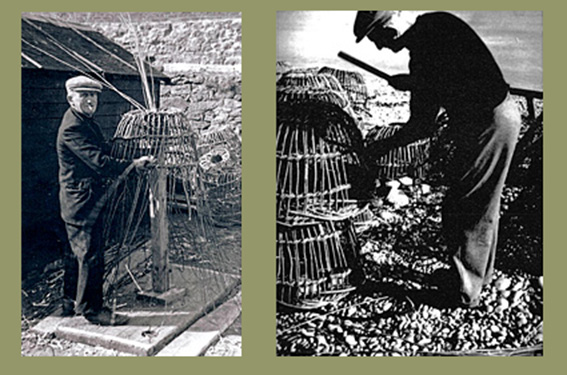
Gent and Walter Mears
A traditional withy pot, was used by generations of fishing families in Budleigh Salterton to catch crabs or lobsters. The pot forms a cage with an inverted funnel opening at the top. In use it is weighted with stones or bricks, baited with a piece of fish and sunk to the bottom of the sea at the end of a buoyed line. To get to the bait a crab or lobster has to crawl up the side of the pot and enter the open funnel. Once in, it is unable climb out. Nowadays the pots are steel framed and covered in nylon net. The “ink well” follows the traditional shape but has largely been replaced by the “parlour pot” which is rectangular in shape.
Two members of the Mears family are shown above, Gent Mears on the left making a pot and Walter Mears on the right repairing one. There is a companion OVApedia article to this one listing the Budleigh Salterton fishing families of the late nineteenth and early twentieth centuries, including the father and grandfather of Walter Mears, illustrated with several photographs (1).
Walter’s son, Gerald, and his grandson, Dave French, have sustained the tradition, and Dave actively promotes the craft by giving demonstrations and selling pots to decorate homes and gardens. Fairlynch Museum has one of his pots. This article attempts to explain a little of the background of how the pots were used and to illustrate the various stages in the weaving process.
A withy pot typically lasted one to one and a half crabbing seasons. The season would start, depending on weather, in April and last until September. In September, the pots would be paired up and moved to deep water grounds, called “The Exeters”. The position of the Exeters is 3.5 to 4 miles directly out from Straight Point. Within this area and following the curve of Lyme Bay, running East-West, is a coral reef and as such, is ideal for crabbing.
To enable the pots to last this long, they needed constant repair. The Mears family had about forty pots in use at any time. The pots continually have to be hand hauled over the side of the fishing boat and forty is as many as can be conveniently operated from a small boat. It takes about five hours to make a pot so a considerable investment in time was needed each year to sustain the number of pots used by each family. Pot making was often carried out by older members of the family. The younger members of the family would start learning to make a pot by turning the bottoms of the pot in (see below), before progressing to making a full pot.
The material used is the willow withy, the strong flexible stems that sprout with profusion when willow is coppiced or pollarded. When cut green, at the end of November, it is flexible enough to work without soaking. After a few months it dries to a brown colour and before it can be worked needs soaking at a rate of one day for each foot of length, so a nine foot rod (typical length) would need approximately nine days of soaking. Brown willow is not to be confused with buff willow which has been boiled and the bark removed. Basket makers use this. Buff willow can be used for pots intended for decorative purposes since it lasts longer out of water than green willow.
By the end of the nineteenth century the bulk of the withies were shipped down by rail to Budleigh Station from the Somerset levels, though there were some small willow beds locally, one of which was at the rear of Walter’s garden in Meadow Road.
Every pot, even the three-quarter sized ones often now made for decorative purposes, starts with an initial twelve withy rods inserted in a pot stand or “mule”. These form the initial ribs of the pot. The process to weave the mouth of the pot commences and, immediately after this a further two rods are inserted into the weave on either side of the existing ribs giving a total of 36, as illustrated below.
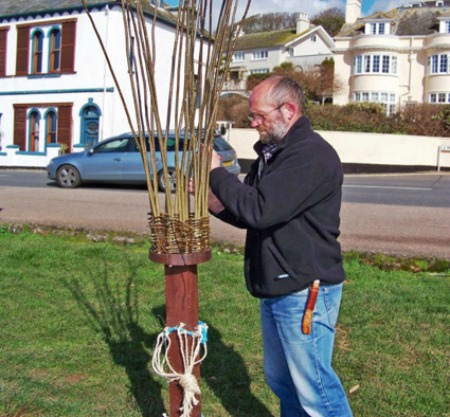
Dave French starting to make a pot
The mouth of a working pot has an approx diameter of 8”-10”, the depth of the neck is between 6”-8”, judged using a hand as a guide. The base diameter of a pot is between 28”-30” with a height of approximately 20” depending on how ‘accommodating’ the willow is to being worked! The next photograph shows the main ribs in the process of being turned down to form the basic shape of the pot and tied in with string to the pot stand.

Main ribs being turned down
The next photograph shows the last stage of finishing the pot mouth, leading to the start of forming a withy spiral which gives strength and shape to the body of the pot. The top of the mouth is known as a collar or funnel.

Finishing the mouth and starting the spiral
Forming the spiral is the part of the process which governs the shape of the pot (known as spiralling or ringing). A bunch of about six withies are twisted, wound and woven around the rods. The left hand is constantly moving between the main rods, to keep the correct spacing, and the bunch of withies forming the spiral to hold the tension. At the same time new withies are continually being introduced to produce a long enough “rope” to reach several times around the pot to the base. When the withies have lots of new growth forming, this causes many small cuts and much chaffing to the hands. The pair of photographs below illustrates this process. As the spiral comes past the mid-way point of the pot, it begins to hold the shape and the strings can be gradually released.
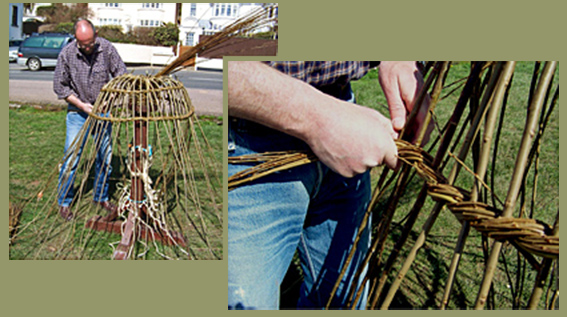
Weaving the spiral around the pot
As the pot is being made, more vertical ribs are added to keep the pot straight (and to keep the crabs from getting out) by weaving them either into the collar or into the spiral; as a guide the space between each rib should be no more than about the width of two fingers. A finished pot would have approximately 60-66 vertical ribs. In addition between 250-300 withy rods would be needed to form the spiral and further 9-ft rods to fill in the base. The next two photographs show the pot taking its basic shape and the pot being tapped into its final form before the base is woven.
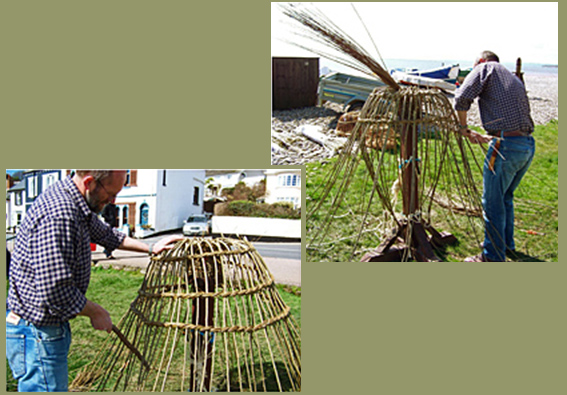
Pot takes its shape
Once the pot is removed from the mule, a count of the ribs is done. Normally, four would be folded down and the next four left up. This process is continued around the pot though fewer might be folded on a small pot. After this, a check is done on the final shape of the pot and the centre of the base is locked into position by gathering the withy that has been folded down and turning this over and under from the centre working outwards - as shown below. The reinforced part of base is called the chime/or chim.

Making the base
The ribs left upright are then folded down, cut and inserted around the bottom spiral in between the ribs to protect the base of the pot from chaffing. This is shown in the following photograph of the pot on its side.
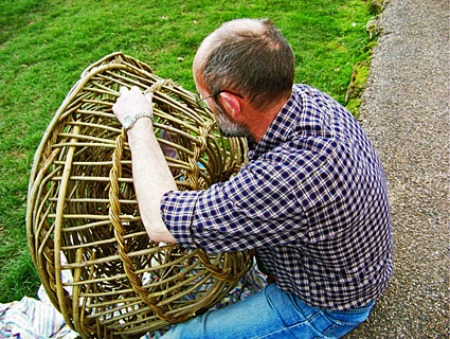
Reinforcing the spiral at the base
The last process is to trim the loose ends. Like most crafts, weaving a crab pot was handed down from father to son and nothing beats ‘hands-on’ experience. It would take the average person probably two to three seasons before they would make a reasonably good pot.
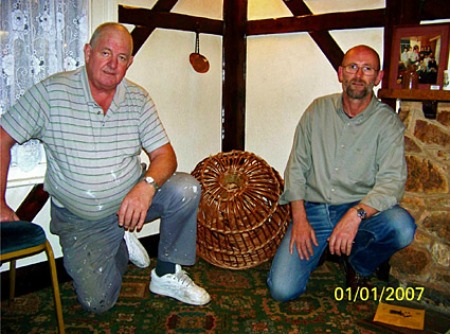
Gerald Mears (son of Walter Mears) and Dave French (grandson of Walter Mears) with finished three-quarters sized pot.
Author:
David French, © 2011
The author acknowledges the help and encouragement he has received over a number of years from Gerald Mears, his uncle, in keeping this craft alive.
References:
1.The fishing families of Budleigh Salterton, C19 and C20. (In preparation)
120 BS-G-00012 any