
Budleigh Salterton is remarkable for being the only town in the East Devon National Landscape. It is also a gateway town to the Jurassic Coast World Heritage Site. Until 1894, it was part of the parish of East Budleigh which at that time was a much larger village. Today, Budleigh Salterton is the largest settlement in the Otter Valley.
 |
 |
 |
The name derives from the salters, who worked the saltpans by the estuary at Ottermouth long ago. The remains of old lime kilns can still be seen in the nearby car park, and there is evidence of an old packhorse route in the atmospheric Dark Lane.
Budleigh Salterton’s natural environment is richly endowed. The beach is famous for its 440 million year old perfectly oval quartzite pebbles, which are significantly older than the adjacent cliffs. It is leased to the council by Lord Clinton for a shilling a year for 999 years with the proviso that there shall be no trading on the beach nor any untoward developments.
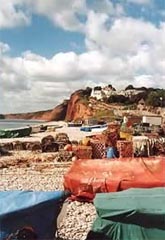
With a couple of cafés and a few fishing boats drawn up on the beach, Lord Clinton’s wishes are fully met, and as a result we have one of the most tranquil and pleasant places to walk beside the sea on the South Coast.
At the west end of the beach lie Steamer Steps where steamers used to pick up passengers for journeys along the coast. Further along is the wall featured in Sir John Millais’ famous picture “The Boyhood of Raleigh” (1870) in which the young Raleigh is shown listening eagerly to a sailor’s yarn. At the eastern end of the promenade lies the Otter estuary which is a nature reserve and an Area of Special Scientific Interest.
Here on the salt marshes, birds of many varieties live, rest or over-winter. As well as seabirds, you can see kingfishers, egrets and herons as well as many varieties of duck and rarer visitors.
The Lower Otter Riverside Walk starts here and is a delight for bird watchers, nature lovers or anyone wanting an escape.
Alternatively, A Walk round Budleigh Salterton gives a fascinating insight into some of the historically interesting buildings in the town, such as the Octagon where Millais used to stay, and Fairlynch, a marine cottage and home to a museum of local history and interests.
Budleigh Salterton has retained many desirable characteristics that have been lost to the brasher seaside resorts. It is now a flourishing town, full of character and in a superb location, and well deserves its inclusion in the Area of Outstanding Natural Beauty and the World Heritage Site.
There is a lot of information about the history of Budleigh Salterton within the OVAPedia archives (accessible on this website). We have used AI to provide a brief overview of the history of Budleigh Salterton below.
A Brief History of Budleigh Salterton
From fishing hamlet to elegant seaside town
Today, Budleigh Salterton is known as one of Devon's most attractive coastal towns, celebrated for its pebble beach, Regency character and spectacular setting at the mouth of the River Otter. Yet behind its genteel appearance lies a rich history stretching from medieval fishing communities and salt production to Victorian tourism and conservation. The story of Budleigh Salterton is one of a settlement transformed, while never entirely losing its connection to the sea, the estuary and the surrounding countryside. [ova.org.uk], [ova.org.uk], [ova.org.uk]
The Origins of "Salterton"
The name "Salterton" provides an important clue to the town's earliest history. The suffix derives from the production and trade of salt, which was a valuable commodity throughout medieval England. Salt-making was once carried out in coastal areas where seawater could be evaporated, and the settlement that developed near the mouth of the River Otter became known as Salterton. The later prefix "Budleigh" linked the community to the neighbouring manor of Budleigh, distinguishing it from nearby Salterton communities. [ova.org.uk], [ova.org.uk]
For much of its early history, the settlement was little more than a small fishing and coastal trading community, overshadowed by inland centres such as East Budleigh, which was then the principal settlement in the area. [ova.org.uk]
Life on the Coast
The sea dominated daily life for generations. Fishermen launched boats from the beach, while local traders used the coast and estuary for transport and commerce. OVApedia records the importance of the lower River Otter as a centre for coastal trade and maritime activity during the Tudor period, with the estuary playing a far more significant role in local commerce than many people realise today. [ova.org.uk], [ova.org.uk]
Coastal life could also be hazardous. Storms, shipwrecks and difficult landings on the pebble beach were ever-present hazards. The stories of local coastguards and wrecks preserved within OVApedia illustrate the challenges faced by generations of coastal communities. [ova.org.uk], [ova.org.uk]
The Rolle Influence
No family had a greater impact on the development of Budleigh Salterton than the Rolle family. Through their extensive estates at nearby Bicton, they controlled much of the land around the town and influenced its growth over several centuries.
The family's investment in roads, public buildings and local infrastructure helped shape the modern settlement. Many of the town's historic features, including its relationship with the neighbouring Bicton Estate, reflect this long-standing association. [ova.org.uk], [ova.org.uk]
A Victorian Seaside Resort Emerges
The greatest transformation came during the nineteenth century. As wealthy visitors increasingly sought healthy seaside destinations, Budleigh Salterton emerged as a fashionable resort town.
Unlike many Victorian resorts that developed around amusement and entertainment, Budleigh cultivated a reputation for refinement, tranquillity and health. Its mild climate, attractive coastline and carefully planned development appealed particularly to retired military officers, clergy, professionals and affluent families. The many nineteenth-century villas and terraces that still characterise the town date from this period of expansion. [ova.org.uk], [ova.org.uk]
As visitors arrived, new hotels, guest houses, churches and civic institutions were established. The town gradually acquired the elegant appearance that distinguishes it today. [ova.org.uk], [ova.org.uk]
The Estuary and the Sea Wall
The relationship between Budleigh Salterton and the Otter Estuary has continually evolved. One of the most significant nineteenth-century interventions was the construction of embankments and engineering works designed to manage the estuary and reclaim land for agriculture and development. OVApedia's account of The Otter Estuary, Constructing the Embankment describes how these works altered both the landscape and local economy. [ova.org.uk]
These changes influenced the shape of the estuary that residents and visitors recognise today, demonstrating how human activity has long shaped the natural environment. [ova.org.uk], [ova.org.uk]
Community Life
During the nineteenth and early twentieth centuries, Budleigh Salterton developed a vibrant civic and cultural life. Flower shows, literary societies, churches and charitable organisations became important features of the community. OVApedia contains records of events such as the town's flower shows and literary institutes, illustrating how residents actively shaped the town's social identity. [ova.org.uk]
The arrival of distinguished residents, including retired military officers, scientists, clergy and public servants, further contributed to the town's reputation as a cultivated and prosperous community. [ova.org.uk], [ova.org.uk]
Preserving Character
One reason Budleigh Salterton remains distinctive today is that it largely avoided the intensive twentieth-century development experienced by many British seaside resorts. As a result, much of its Victorian and Edwardian character survives.
Its broad seafront, historic buildings and proximity to both the Jurassic Coast and the Otter Estuary continue to make it one of East Devon's most attractive towns. Conservation efforts by local organisations, including the Otter Valley Association, have helped maintain this special sense of place. [ova.org.uk], [ova.org.uk]
A Town Shaped by Sea, River and Landscape
The history of Budleigh Salterton is ultimately a story of adaptation. From medieval salt production and fishing, through maritime trade and Victorian tourism, to modern conservation and community life, the town has continually evolved while retaining a strong connection to its natural setting.
Today, as visitors stroll along the pebbled beach or watch the River Otter meet the sea, they are experiencing a landscape shaped by centuries of human activity and natural change. The result is a town that combines historical depth, architectural charm and environmental importance in a way that is uniquely East Devon. [ova.org.uk], [ova.org.uk], [ova.org.uk]
Facilities available in the town
There are several public houses in the town and also there are cafes and restaurants. On the seafront there is a cafe near Lime Kiln car park, and a Rockfish restaurant near the centre of the beach.
The shops along the High Street and adjoining roads provide all the needs of locals and visitors alike, from fresh produce to hairdressers and chemists, from art galleries to travel agents and several ladies fashion shops. There is also a Post Office, medical centre, veterinary surgery and garage providing petrol.